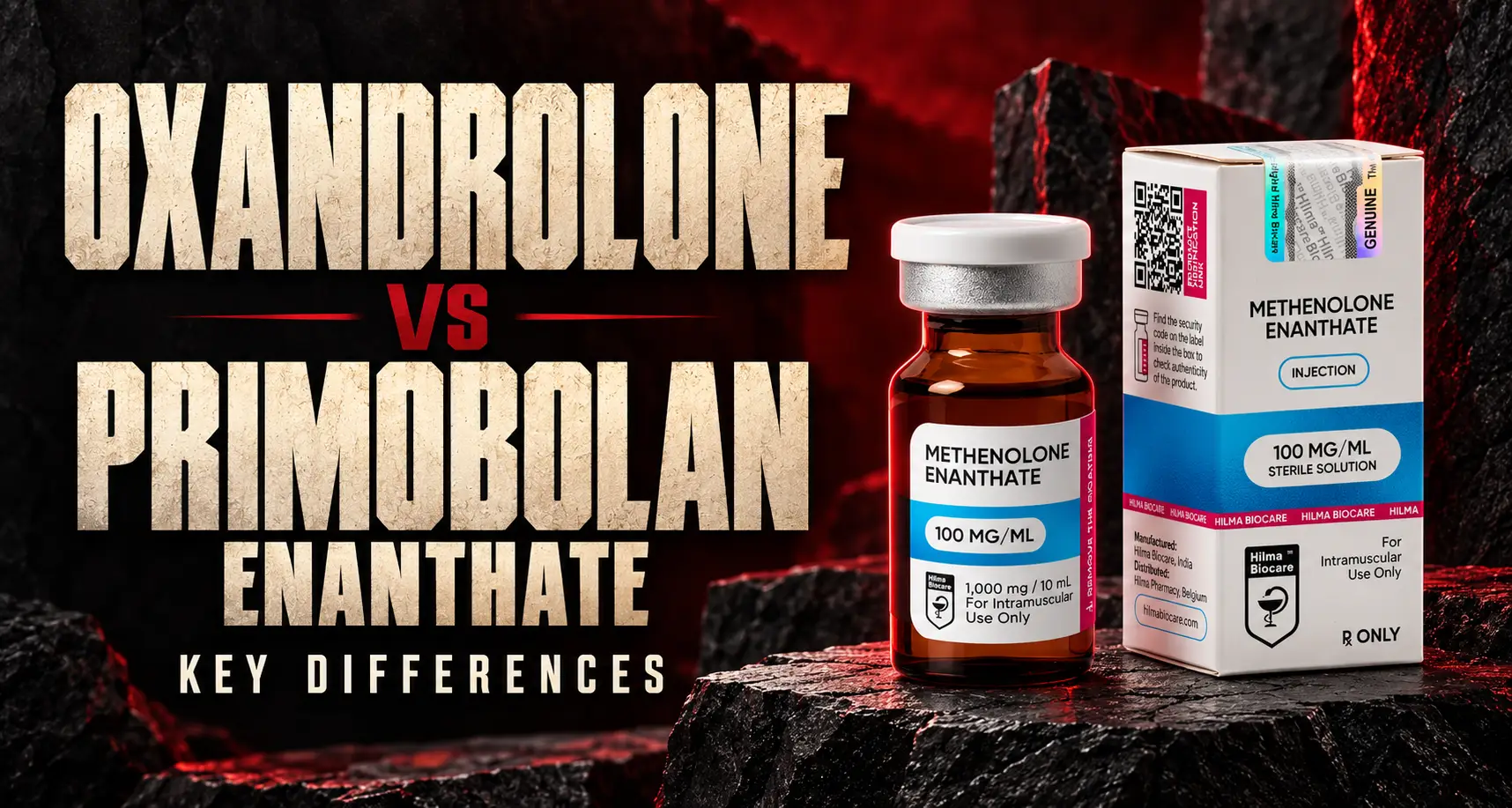
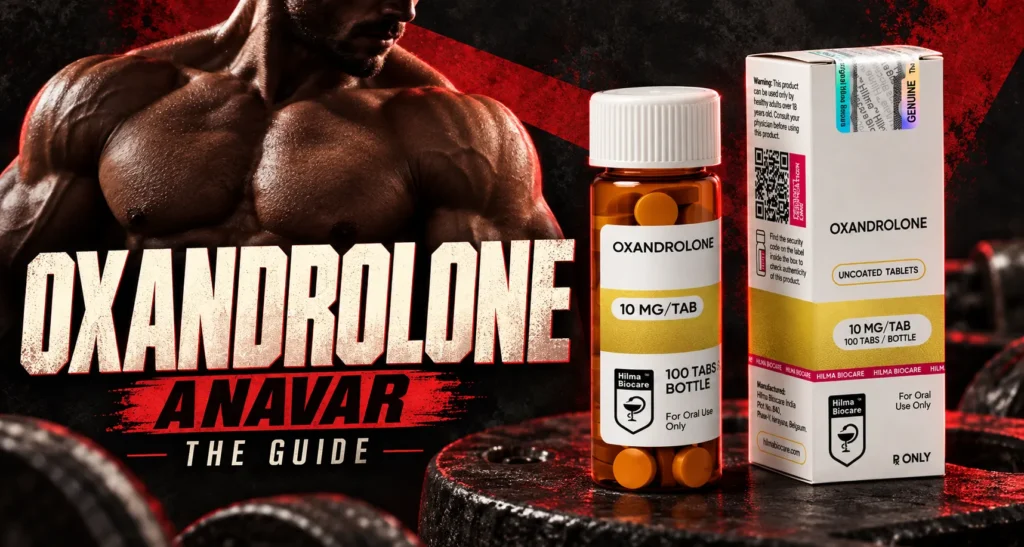
A tablet that clears relatively quickly and an injection that keeps releasing from a muscle depot are both described as “mild.” That shared label hides one of the most useful differences between oxandrolone and Primobolan enanthate: how their effects develop, how long exposure lasts and what happens after it ends.
Both have a reputation for lean gains without conversion into estrogen. That explains why they are often discussed together. It does not make them interchangeable.
The useful question is what these compounds actually share, where their chemistry and delivery separate them, and how much the word “mild” really tells us.
What oxandrolone and Primobolan actually do
Oxandrolone, also known as Anavar, and methenolone are anabolic steroids derived from dihydrotestosterone, or DHT. Both act through androgen receptors and promote the processes involved in building and retaining protein. That is the biological basis of their effects on muscle.
The same action explains their medical history. Oxandrolone has been used to support weight gain after severe illness, surgery or trauma. Methenolone has been used in conditions involving tissue wasting. These applications establish an anabolic effect; they do not predict a particular physique result in a healthy lifter.
Neither compound aromatizes into estrogen. Their reputation for a “dry” appearance comes largely from avoiding water retention caused by that conversion. But body water still responds to glycogen, salt, food intake and health. “Does not aromatize” is a precise description. “Cannot cause water retention” is not.
This also changes how results look. A smaller change on the scale does not automatically mean less muscle growth, just as a rapid weight increase does not prove more muscle tissue. Definition depends heavily on body fat, while fullness changes with glycogen and hydration.
The compounds share these broad characteristics. Their delivery then takes the comparison in different directions.
The tablet and the depot run on different clocks
Oxandrolone reaches the bloodstream after absorption from the digestive tract. A chemical modification called 17 alpha alkylation helps it survive metabolism and remain active by mouth. This makes tablets possible, but also brings the liver and blood lipids into the comparison.
Its prescribing information reports an average elimination half life of about 10 hours in younger adults, with a longer average in older adults. Concentrations therefore fall relatively quickly after the last tablet. That describes the drug in the blood, not the speed of visible muscle growth or the return of normal hormone production.
Methenolone enanthate, the injectable form of Primobolan, arrives through an oil depot in muscle. The ester changes its release pattern: the compound leaves the injection site gradually, and enzymes separate the ester from methenolone.
Exposure continues after the injection itself is over. The product information describes a slow rise followed by a slow decline. Longer release smooths the delivery pattern, although concentrations still change over time.
Think of a tap and a reservoir. Stopping tablets stops new oral doses. Stopping injections leaves the existing reservoir releasing its contents. Neither event instantly reverses the biological effects already set in motion.
That distinction extends beyond this pair. Our comparison of injectable and oral steroids explains how absorption and ester length change the timing of exposure.
Oxandrolone vs Primobolan enanthate at a glance
Feature
Oxandrolone
Primobolan enanthate
Form
Oral tablet
Oil solution for intramuscular injection
Delivery
Digestive absorption followed by metabolism
Gradual release from an injection depot
After the last dose
Blood concentrations decline relatively quickly
Residual release continues from the depot
Aromatization
No conversion into estrogen
No conversion into estrogen
Liver profile
17 alpha alkylation carries a recognized liver injury risk
Different chemical profile; liver monitoring still matters
Blood lipids
Pronounced HDL reduction is a recognized concern
Injection does not eliminate lipid effects
Natural hormones
Suppresses endogenous hormone production
Suppresses endogenous hormone production
These are differences between two specific compounds. The broader categories of oral steroids and injectable steroids contain substances with different chemistry. Route alone is not a safety ranking.
Why “dry” says little about your own hormones
Natural testosterone production runs on a feedback loop. Signals from the brain regulate LH and FSH, the hormones involved in testicular testosterone production and sperm production.
An androgen supplied from outside the body changes that feedback. LH and FSH fall, reducing the signal to the testes. This is suppression, and the absence of aromatization does not prevent it.
There is a second connection. Much of a man’s estradiol is produced from testosterone. When natural testosterone falls, the supply of raw material for estradiol falls too. Neither oxandrolone nor methenolone replaces it through aromatization.
For some men, this means low testosterone together with low estradiol. Both hormones contribute to sexual function, and estradiol also matters for bone health. Low libido or weaker erections therefore need more explanation than “this compound does not raise estrogen.” Symptoms and blood tests have to be considered together.
The important distinction is between avoiding an increase in estrogen and preserving normal hormone function. Those are separate outcomes.
What happens to the result after stopping?
This is where the discussion usually becomes a question about percentages: how much of the result stays? There is no dependable figure for either compound.
Some early changes in weight reflect glycogen and water. Some reflect tissue. Losing fullness after discontinuation is not identical to losing the same amount of muscle, and a less dramatic change on the scale does not prove that everything has been retained.
Hormonal recovery adds another variable. The external androgen signal fades, while natural production follows its own recovery timeline. During that interval, low hormone levels affect energy, sexual function and the conditions needed to maintain muscle.
Training, adequate nutrition and sleep remain important. They do not determine the outcome alone. Previous exposure, the extent of suppression and the course of recovery also matter.
The shorter persistence of oxandrolone makes the decline in drug exposure faster than with an enanthate depot. It does not turn recovery into a switch that flips when the last tablet clears.
What bloodwork adds to the comparison
The mirror shows appearance. It does not show HDL cholesterol, hematocrit or the signals controlling testosterone production. Those measurements explain why two people with similar visible results can have different biological responses.
Marker
What it helps explain
Relevance here
Testosterone, LH and FSH
Suppression and the course of hormonal recovery
Relevant to both compounds
Estradiol
The estrogen side of the hormonal picture
Interpreted with testosterone and symptoms
HDL and LDL
Changes in blood lipids
Especially important with oxandrolone, but relevant to both
ALT, AST and other liver markers
Evidence requiring assessment of liver injury and other causes
A cardiovascular measurement outside the blood panel
Relevant to both compounds
Context matters here. Hard resistance training raises AST and ALT in some people because these enzymes also come from muscle. CK, GGT, bilirubin, symptoms and the timing of exercise help a clinician interpret the pattern. A single elevated marker does not tell the whole story.
Post cycle therapy, usually shortened to PCT, exists as a concept because suppression persists beyond the decision to stop. The brain and testes need to resume their usual signalling, and the pace varies between people.
In the HAARLEM study, testosterone returned to normal within about three months in most participants after androgen use ended. Sperm production generally took longer to recover. These were observations across users of different regimens, not a guaranteed timetable for oxandrolone or Primobolan.
Clomiphene and tamoxifen are often discussed under the PCT label because they alter estrogen feedback. Whether medication is appropriate depends on symptoms, laboratory findings and fertility goals. The HAARLEM study did not demonstrate a recovery benefit from the PCT regimens participants used; that observational finding also does not settle every individual clinical case.
The enanthate depot adds a timing issue because androgen release continues after the last injection. A calendar based only on that last injection cannot establish whether hormonal recovery has occurred.
Fertility deserves a separate assessment. Normal testosterone does not confirm normal sperm production. For someone planning children, semen testing answers a question that a testosterone result cannot.
So what is the real difference?
Oxandrolone and Primobolan enanthate share an anabolic action and a lack of aromatization. Their chemistry and delivery create different exposure patterns and different monitoring priorities.
Oxandrolone provides oral delivery with relatively rapid changes in blood concentration. Its modification for oral activity brings particular concerns for liver health and HDL cholesterol. Primobolan enanthate releases gradually from an injection depot, extending exposure after administration has stopped. Its liver profile differs, but injection does not remove hormonal or cardiovascular effects.
“Mild” describes only selected parts of that picture. The meaningful comparison is how each compound acts, how long it remains active and how the body responds during and after exposure. That explains far more than deciding which one deserves the softer label.